

trinamiX PAL One Textile Scanner
The trinamiX PAL One Textile Scanner is a portable textile NIR scanner for textile material identification, nylon sorting, wool verification, and selected textile-related applications. It is designed for users who need fast material information directly at a sorting station, during incoming goods inspection, or within quality control workflows.

One of the strongest textile-specific applications is PA6 / PA66 differentiation. This capability supports nylon 6 and nylon 66 sorting for textile recycling, textile pre-sorting, and material streams where PA6 and PA66 must be separated before further processing.
The trinamiX PAL One Textile Scanner is a handheld NIR scanner that identifies textile materials directly on-site and supports applications such as PA6/PA66 differentiation, nylon sorting, wool verification, and textile material classification.
Request sample evaluation | Request rental availability | Download trinamiX textile scanner brochure
Portable Textile Material Identification with NIR Technology
The system uses near-infrared spectroscopy (NIR) to identify textile materials based on their spectral response. The operator places the handheld textile scanner directly on the textile sample and receives the result in the trinamiX application environment.
- Portable textile material identification
- PA6 / PA66 differentiation for nylon sorting
- Wool verification
- Blend classification within the application scope
- Color-coded results for fast sorting decisions
- Cloud-based result storage and export options
PA6 / PA66 Differentiation for Nylon 6 and Nylon 66 Sorting
PA6 and PA66 are both nylon materials, but they should not always be mixed within the same recycling stream. The PAL One textile scanner can support PA6 / PA66 differentiation for suitable textile samples and sorting workflows.
This is especially relevant when textile recyclers, material handlers, and research teams need to separate nylon-rich fractions before downstream processing.
- Supports textile recycling pre-sorting
- Helps separate PA6 and PA66 fractions
- Provides confidence levels in the application
- Supports faster decisions than laboratory testing for every sample
For broader textile recycling workflows and fiber sorting applications, see textile recycling NIR scanner for PA6/PA66 and fiber sorting. For technical background, see why PA6 and PA66 must be separated in textile recycling.
Supported Textile Materials
The standard textile application supports common textile materials and selected blends. Exact results remain sample-dependent and depend on the licensed application, sample type, surface condition, and measurement setup.
| Material / function | Typical use |
|---|---|
| Cotton | General textile identification |
| Polyester | Textile sorting and blend classification |
| Viscose | Fiber identification |
| Polyamide / Nylon | Nylon-rich textile sorting |
| PA6 / PA66 | Nylon 6 and nylon 66 differentiation with the relevant application |
| Wool | Wool-rich material verification |
| Elastane, acrylic, silk and selected blends | Application-dependent textile classification |
Measurement Workflow
The measurement workflow is designed for practical use by operators. Results are available within seconds and can be used to support sorting, documentation, quality control, or further testing decisions.
- Place the scanner directly on the textile sample.
- Start the measurement in the relevant trinamiX application.
- Review the material result, confidence level, or color-coded sorting output.
- Use the result for sorting, material verification, or sample selection.
The system can be used with mobile and desktop application environments, depending on configuration. For dedicated textile material verification workflows, see Textile Material Verification with Portable NIR for details.
Wool Verification and Wool Sorting Support
The wool application supports quick verification of wool-rich materials. It can be useful for textile recyclers, resale workflows, incoming goods inspection, and wool sorting workflows where wool content must be confirmed quickly.
- Fast scan workflow
- Color-coded output
- Useful for knitted goods and wool-rich textile fractions
Typical Use Cases
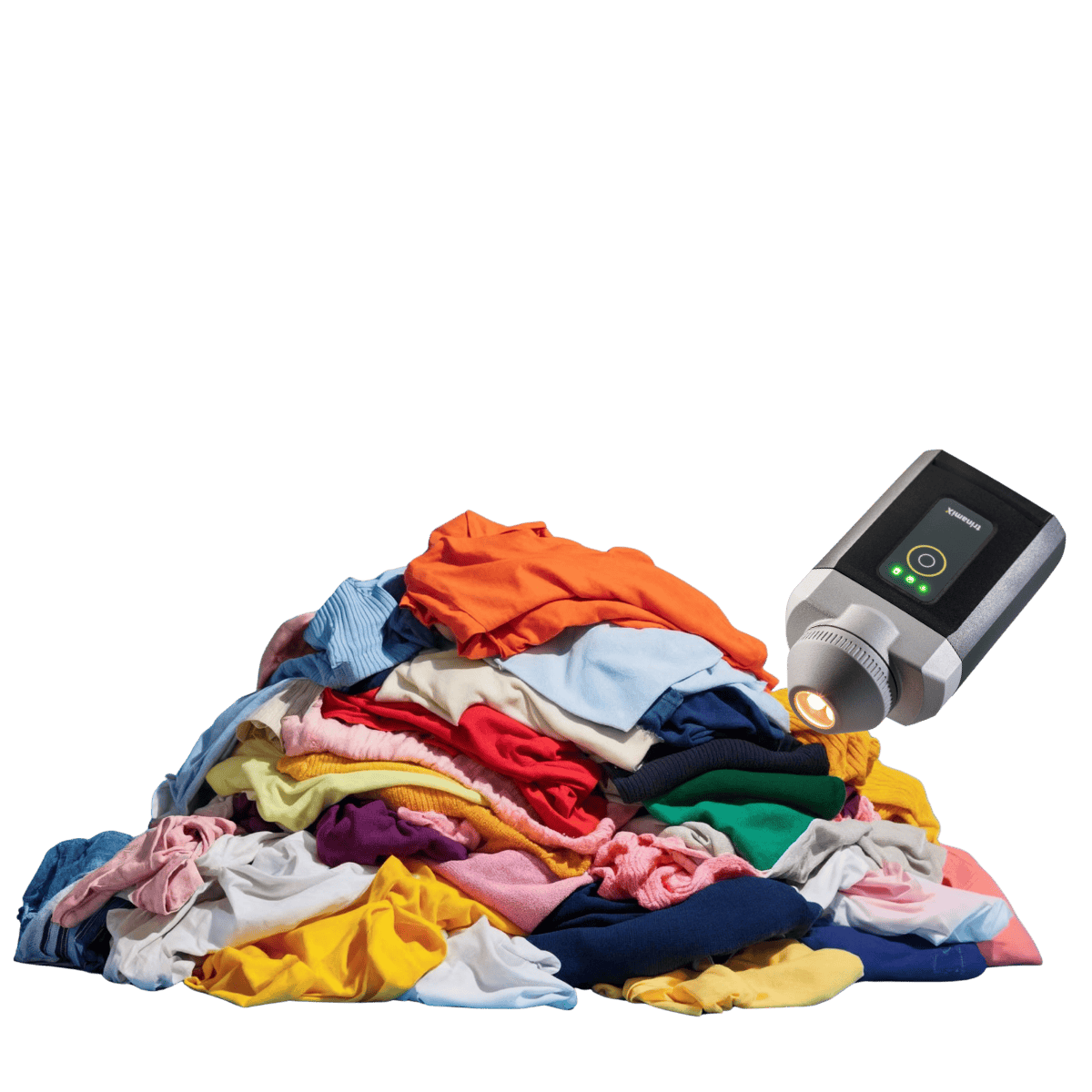
The textile scanner is most useful where fast textile material identification supports operational decisions. It is not intended to replace laboratory analysis, but it can reduce the need to send every uncertain sample to a laboratory.
- Textile recycling pre-sorting
- PA6 / PA66 nylon sorting
- Incoming goods inspection
- Wool verification
- Manual sorting station support
- Quality control and sample selection
Technical Specifications
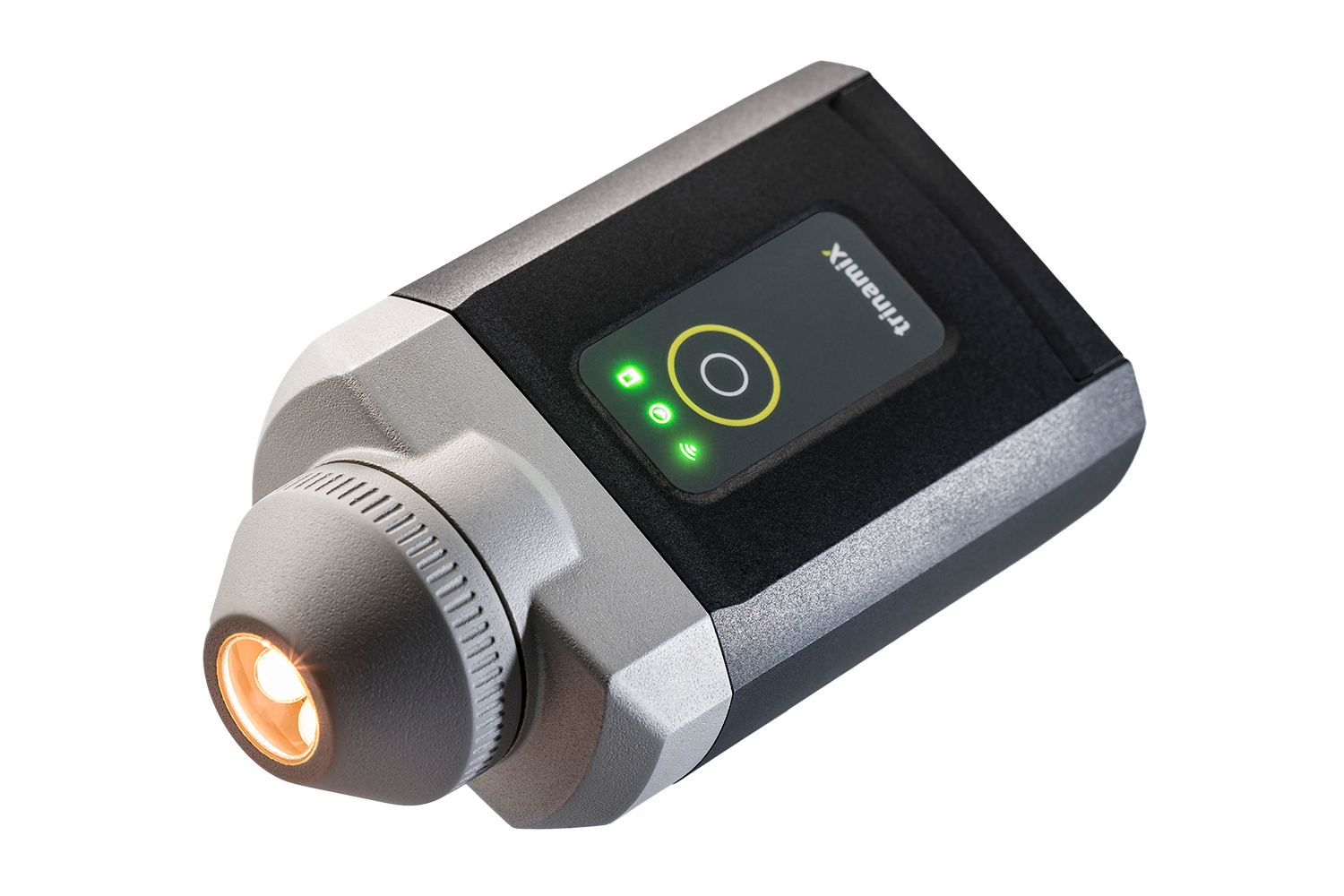
The PAL One is a handheld NIR spectrometer designed for portable textile material identification workflows.
- Device type: handheld NIR spectrometer
- Weight: approximately 560 g
- Battery: up to 6,000 measurements per charge
- Applications: Android, iOS, and Windows environments depending on setup
- Data handling: cloud-based result storage and export options
- Use mode: handheld measurement; optional table-based workflow possible
Download trinamiX textile scanner technical datasheet
Downloads and Technical Resources
For evaluation, start with the brochure and technical datasheet. For application suitability, sample testing is usually more useful than reading specifications alone.
Optional Table-Based Workflow
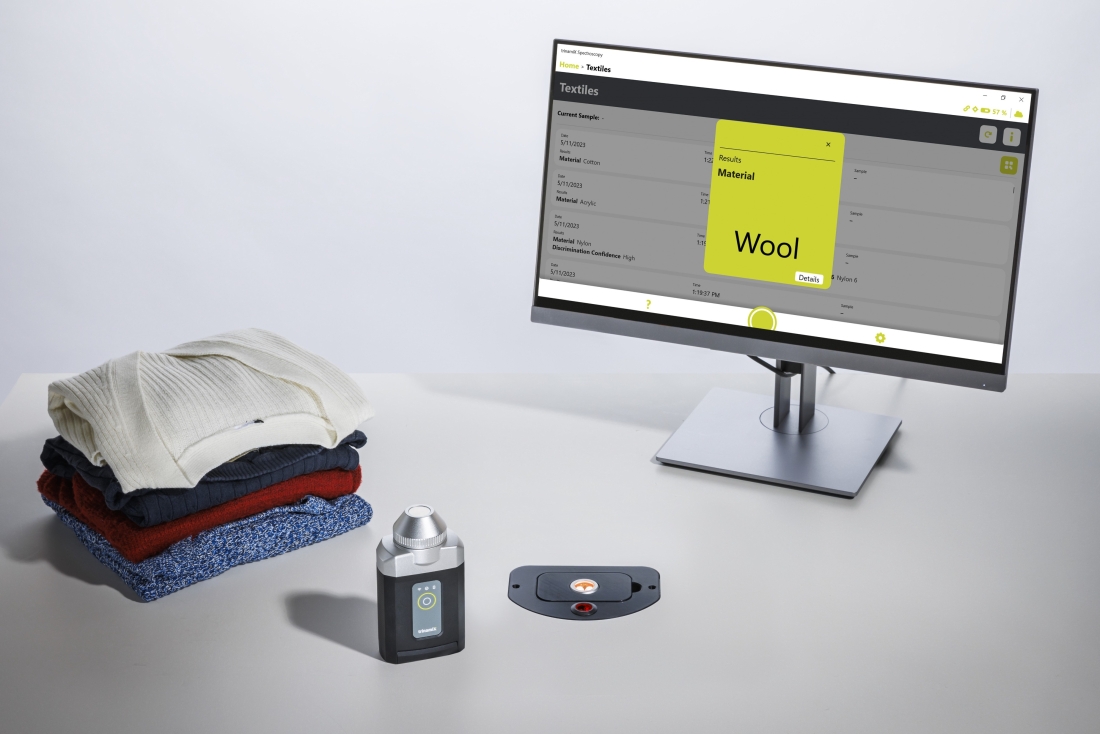
The PAL One can also be used in a semi-automated table-based setup. This should be treated as an implementation option, not the main reason to choose the system.
A table-based workflow can be useful when handheld scanning becomes too slow for a repetitive manual sorting station. The scanner remains removable and can still be used as a handheld device.
- Supports faster manual sorting workflows
- Can reduce operator handling steps
- Useful for repetitive textile inspection tasks
Additional Textile-Related Applications
Carpet and PU mattress applications are available as special use cases. They are not the primary focus of this page, but they may be relevant for specific recycling or material verification tasks.
- Carpet sorting: distinction of common carpet materials such as nylon, wool, PAN, PET, PP, and PTT.
- PU mattress analysis: qualitative composition checks for selected polyurethane components.

What This Method Can and Cannot Do
Portable NIR textile analysis is a screening and identification method. It supports operational decisions and textile sorting workflows, but it is not a laboratory replacement.
| Question | Practical answer |
|---|---|
| Can it identify common textile materials? | Yes, within the scope of the licensed textile application. |
| Can it distinguish PA6 and PA66? | Yes, for suitable samples using the relevant PA6 / PA66 application. |
| Can it replace laboratory testing? | No. It supports fast screening and sorting decisions, but laboratory analysis may still be required for critical cases. |
| Can it identify every blend or contaminated textile? | No. Results are sample-dependent and depend on sample condition, composition, surface, and application scope. |
Request Sample Evaluation
If you are unsure whether your textile stream can be identified reliably, the best next step is a sample evaluation. This helps confirm whether the PAL One textile scanner application fits your material and workflow before purchase or rental.
Request Rental Availability
For temporary sorting trials, recycling projects, or feasibility checks, rental availability can be discussed based on application, location, expected duration, and sample volume.
Request a Configuration
The correct configuration depends on the application modules required for your workflow.
FAQ: trinamiX PAL One Textile Scanner
Can the scanner distinguish PA6 from PA66?
Yes. With the relevant textile application and suitable samples, the PAL One textile scanner can support PA6 / PA66 differentiation for nylon 6 and nylon 66 sorting workflows.
Is this only for textile recycling?
No. Textile recycling is a major use case, but the scanner also supports incoming goods inspection, quality control, wool verification, and textile material identification.
Can I buy the scanner online?
Selected configurations may be available through the online shop. For PA6 / PA66 workflows or special applications, a sample evaluation or configuration request is recommended before purchase.
Does the scanner replace laboratory testing?
No. It is a screening method designed for fast operational decisions. Laboratory testing may still be required for critical or disputed results.
Can the handheld scanner be integrated into a table workflow?
Yes. A table-based workflow can be discussed for repetitive manual sorting tasks, but it should be considered an implementation option rather than the main buying reason.