

Packaging Recyclability Compliance and Verification
Validate Packaging Recyclability, Sortability, and Compliance in Real-World Conditions
New regulatory reality: from recyclable design to proven performance.
Packaging Recyclability Compliance Requires Measurable Evidence
Regulatory frameworks such as PPWR and California SB343 require packaging to demonstrate real-world recyclability performance.
This includes a critical condition:
Packaging must be detectable and sortable in real recycling systems.
If packaging cannot be detected:
- it is not sorted
- it is not recycled
- recyclability claims may not be valid
This shifts compliance from design assumptions to measurable system compatibility.
What Causes Packaging to Fail in Practice?
Common design features that reduce sortability include:
- carbon black and dark pigments
- metallic inks and decorative coatings
- barrier layers and functional coatings
- multilayer films and laminated structures
These features can make packaging invisible to optical sorting systems, even when the base material is recyclable.
Understand the Technical Mechanism
Learn how optical sorting systems evaluate plastics and how NIR reflectivity determines whether packaging is detected in practice.
Why This Matters for PPWR and SB343
Both PPWR and SB343 shift the definition of recyclability toward demonstrated performance in real systems.
This means:
- recyclability claims depend on successful sorting
- optical detectability becomes part of compliance evidence
- material selection alone is no longer sufficient
As a result, sortability testing becomes a critical verification step in packaging development and documentation.
Packaging Recyclability Regulations: PPWR, SB343, and Global Requirements
Regulatory frameworks are rapidly shifting from “theoretical recyclability” to proven, system-compatible recyclability. The EU’s PPWR requires evidence that packaging can be effectively sorted in real recycling streams, not just that it is made from recyclable materials. In parallel, California’s SB343 restricts recyclability claims unless materials are widely accepted and processed in practice.
This creates a shared requirement across regions:
packaging recyclability claims increasingly depend on demonstrable compatibility with sorting infrastructure.
Optical sorting — especially near-infrared (NIR) detection — is a decisive step in this process. If packaging cannot be detected and classified correctly, it will not enter recycling streams, regardless of material type.
Spectral sensing technologies enable fast, objective validation of these criteria, supporting compliance workflows across both EU and US regulatory contexts.
The Compliance Gap: Design for Recycling vs. Real-World Recyclability
Many packaging formats are technically recyclable — but fail in practice.
The reason lies in the disconnect between:
- Material selection (e.g., PET, PP)
- System behavior in optical sorting facilities
Common design features interfere with NIR detection:
- Carbon black and dark pigments
- Metallic inks and decorative elements
- Barrier layers and coatings
- Multi-material films and laminates
These features can render packaging invisible to sorting systems.
Result:
- Not detected → not sorted
- Not sorted → not recycled
- Not recycled → non-compliant under PPWR and SB343
This gap is increasingly exposed through audits, recyclability scoring, and regulatory scrutiny.
Why Optical Sortability and NIR Detectability Determine Packaging Recyclability Compliance
Modern recycling systems rely on near-infrared (NIR) spectroscopy to identify and separate plastics.
Sortability is therefore not theoretical — it is sensor-dependent.
If packaging does not meet minimum reflectivity thresholds:
This makes NIR detectability a measurable compliance parameter, not just a technical detail.
Measurable Recyclability Verification Through Spectral Sensing
Spectral sensing provides a direct way to verify whether packaging meets sorting requirements.
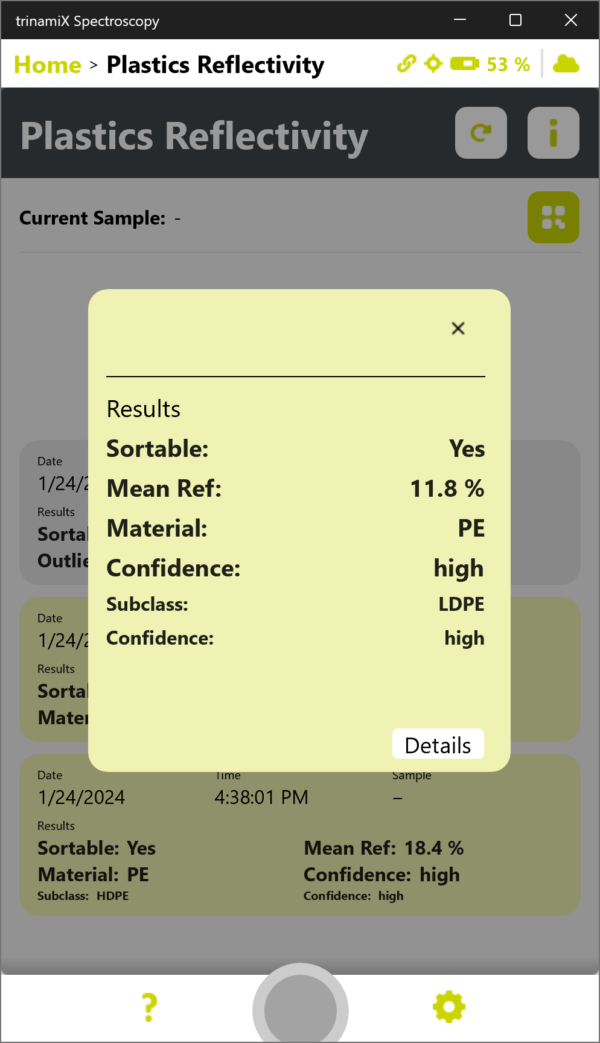
trinamiX Reflectivity Check enables fast, in-field validation of:
- NIR reflectivity (%)
- Sortable / not sortable classification (based on industry thresholds)
- Material detectability
Measurements are performed in seconds — without laboratory infrastructure.
This allows teams to move from assumption to data-backed validation.
Where Spectral Verification Fits in Packaging Compliance Workflows
A typical packaging compliance workflow increasingly includes:
- Material and packaging design
- Spectral validation of sortability (NIR reflectivity)
- Third-party evaluation (e.g., RecyClass)
- Packaging recyclability compliance, verification, and recyclability claims (PPWR, SB343, and related frameworks)
Spectral sensing acts as the verification layer between design and certification, ensuring that only compliant packaging progresses.
When to Use Recyclability Verification Testing
1. Before certification or submission
Validate sortability before engaging with RecyClass or retailer requirements.
2. During R&D and material selection
Quickly assess how pigments, additives, or structures impact detectability.
3. For packaging recyclability verification, compliance documentation, and recyclability claims
Support packaging recyclability claims with measurable, reproducible verification data.
FAQ
What is packaging recyclability verification?
Packaging recyclability verification is the measurement-based assessment of whether packaging performs within real recycling systems, including detection and separation in optical sorting processes.
Why do PPWR and SB343 require measurable recyclability evidence?
Both PPWR and SB343 move beyond theoretical recyclability by requiring evidence that packaging is compatible with real collection, sorting, and recycling conditions before recyclability can be claimed or documented.
Why does optical sortability matter for packaging compliance?
Optical sortability matters because packaging that cannot be detected and classified correctly in sorting systems may fail to enter recycling streams, which affects recyclability verification and compliance.
What does NIR detectability mean in packaging recycling?
NIR detectability describes whether packaging can be recognized by near-infrared sorting systems used to identify and separate plastics in recycling operations.
Who This Page Is For
- Packaging sustainability managers
- Packaging R&D and material engineers
- Regulatory and compliance teams
- Recycling and material evaluation specialists
Summary
Packaging recyclability compliance is evolving toward measurable system compatibility.
Regulations such as PPWR, SB343, and related frameworks require that packaging recyclability is not only designed — but verified under real conditions.
Spectral sensing provides the missing verification layer:
a fast, objective method to verify whether packaging will actually be sorted and recycled.