

Identify Plastics On-Site
– Fast, Reliable, and Portable
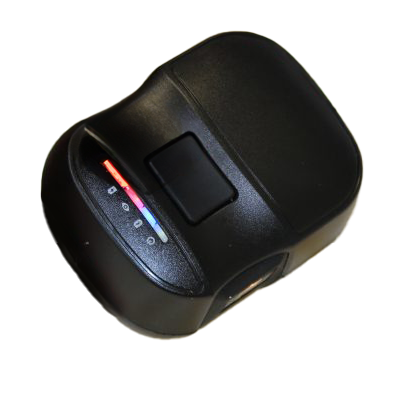
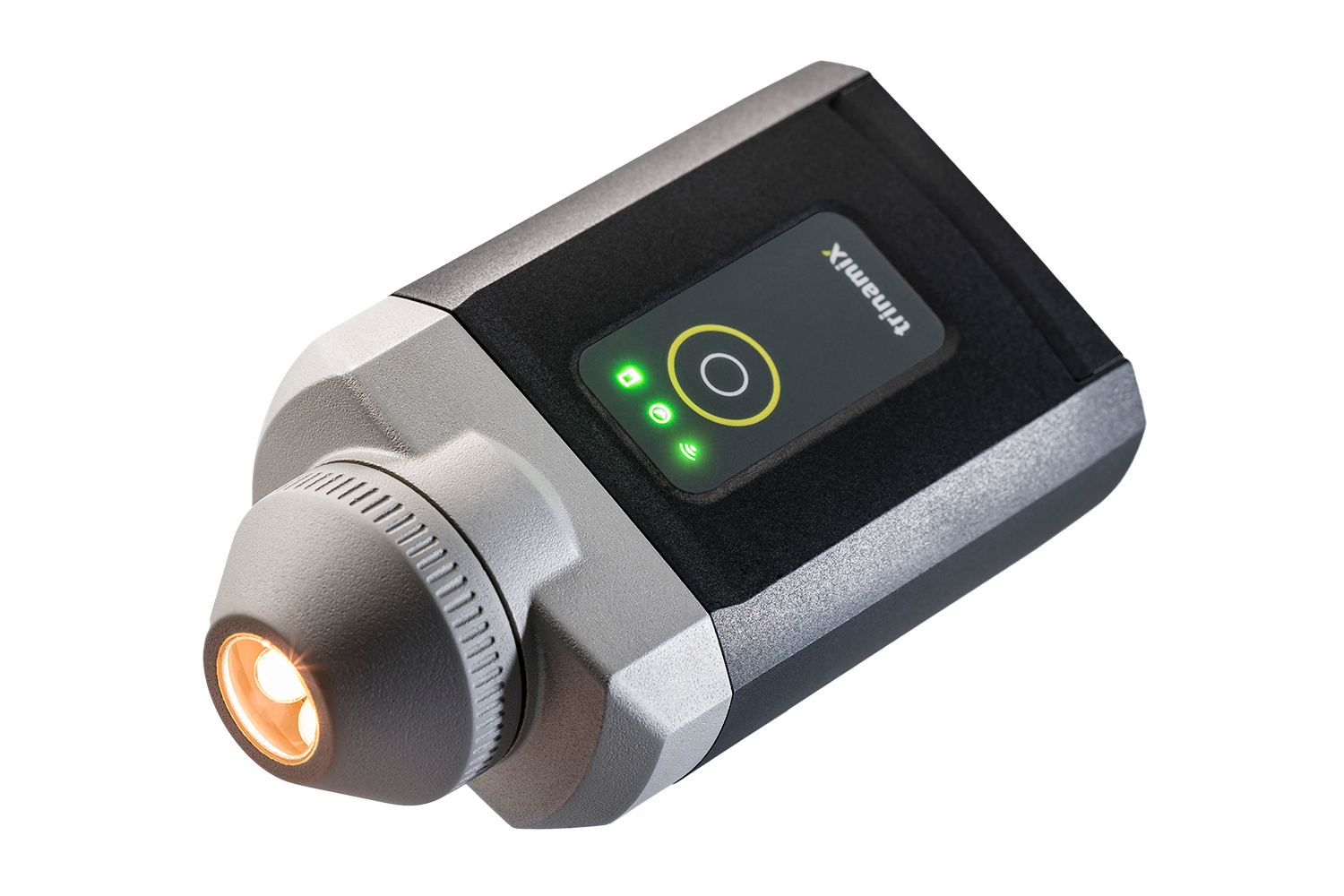
The trinamiX PAL One is a handheld near-infrared (NIR) spectrometer that identifies plastic types based on their spectral fingerprint. It is designed for recyclers, QA teams, and sustainability professionals who need fast, on-the-spot decisions without lab equipment.
From simple polyolefins to complex multilayer films and technical polymers, you get actionable insights in seconds.
Table of contents
Why Plastic Identification Matters
- Ensure clean material streams for recycling
- Avoid non-conformities in incoming goods
- Evaluate recyclability of packaging during product development
- Document material types for audits or customers
Portable Material Analysis with trinamiX PAL One
- Battery-powered handheld spectrometer
- App available for Android, iOS, or Windows
- Secure cloud access for documentation and export
- Works offline with optional cloud sync
- Used worldwide in recycling, QA, and R&D
Key Applications for Plastics
| Application | What It Solves | Link |
|---|---|---|
| 10 Plastics | Identifies the most common plastic types for sorting or QA | Go to Plastics |
| Plastics Max | Extended identification incl. ABS, PBT, PET-G, PSU, etc. | Go to Plastics |
| Reflectivity | Sortability evaluation based on NIR reflectivity (APR guideline) | Go to Reflectivity |
| Multi-Material Films | Detects multilayer structures and PA content in % | Go to Films |
| PE/PP Quantification | Checks material ratios in blends and compounds | Go to PE/PP |
| Correlation App | Verifies if a material matches your reference (QA use) | Go to Correlation |
Not sure which application is best for you?
Designed for Operators and Engineers
- Easy one-button operation with instant results
- Detailed data access via secure cloud portal
- License only what you need – upgrade anytime
- Can be integrated into a manual sorting table
We will find the right configuration for you → Get in touch
How It Works
- Place the scanner on the sample
- Press the button – NIR light is emitted and reflected
- The app shows the result within ~2 seconds
- Optional: result is uploaded to the cloud portal
Who Uses This?
- Recycling plants with plastic sorting (MRF)
- QA and lab managers in plastics manufacturing
- Sustainability and packaging engineers
Related Solutions
Limitations of NIR Spectroscopy for Moisture Measurement in Plastics
Moisture can strongly affect polymer processing, especially for moisture-sensitive materials such as polyamides, polyesters, PC or PMMA. It can influence dimensional stability, extrusion behavior, hydrolytic degradation and final material properties.
Near-infrared spectroscopy can detect water because O–H bonds create characteristic absorption features in the NIR range. However, detecting a spectral difference is not the same as making a reliable quantitative moisture measurement.
In plastics, moisture levels are often very low and the required precision can be below one percent. At this level, the water-related signal is usually weak compared with the spectral response of the polymer matrix, additives, fillers, pigments, surface condition and sample geometry.
For this reason, portable NIR systems used in recycling, incoming goods inspection and plastic QA are primarily suited for polymer identification, material verification and sorting decisions. Precise moisture measurement in plastics usually requires controlled sampling, reference data and application-specific chemometric calibration.
For a broader explanation of when NIR moisture measurement works well, and where its limits are, see our guide to NIR moisture measurement.
FAQ
Can I identify black plastics?
No. Most carbon black materials cannot be reliably identified using NIR spectroscopy due to very low reflectivity.
Can I use the device without internet?
Yes. You can scan materials and get results offline. Internet is only required for cloud reporting and data synchronization.
Is the device upgradeable?
Yes. All software applications are licensed individually and can be added later without changing the hardware.
Does the scanner support other materials like textiles?
Yes. The same trinamiX PAL One device can be used for textiles, including blends, wool, and PA 6/6.6. Learn more about textile analysis solutions here.
Can NIR spectroscopy measure moisture in plastics?
NIR spectroscopy can detect water absorption in polymers in principle, but reliable moisture measurement in plastic materials is challenging. Moisture concentrations are typically very low and polymer absorption bands often dominate the spectrum. As a result, handheld NIR systems used in recycling and quality control are primarily optimized for polymer identification rather than precise moisture quantification.