

Flexible Packaging Recyclability Screening
Flexible packaging recyclability depends not only on the declared polymer type, but also on the actual film structure and multilayer laminate composition. A flexible film may appear to be a simple mono-material polyolefin packaging material while containing barrier layers, EVOH, PA content, or mixed-material combinations that affect recycling stream compatibility.
Flexible packaging structure analysis is often used during early packaging development workflows to identify whether a film behaves like a mono-material structure or a multilayer laminate that may affect recycling stream compatibility. It helps packaging developers, sustainability teams, converters, and recyclers perform early recyclability assessment workflows before laboratory analysis or formal recyclability testing.
This page explains how portable NIR screening can support multilayer packaging screening, mono-material packaging testing, and PE/PA film screening in practical packaging development workflows.
Table of contents
_____________
- Why Flexible Packaging Needs Structure Screening
- Where This Fits in Packaging Evaluation
- Flexible Packaging Screening Workflow
- What Portable NIR Screening Can Detect in Flexible Packaging Structures
- Typical Use Cases
- Important Limitations
- Relationship to Reflectivity and Sortability Testing
- Device and Application Setup
- Test Your Packaging Material
- FAQ: Flexible Packaging Recyclability Screening
Why Flexible Packaging Needs Structure Screening
Flexible packaging structure screening is used to determine whether a film behaves like a mono-material film or a multilayer packaging structure during recyclability assessment workflows.
Many flexible packaging formats combine several materials to achieve barrier performance, sealing behavior, mechanical stability, or product protection. These functional layers can improve packaging performance but may create challenges for flexible film recyclability assessment when the structure is not compatible with the intended recycling stream.
For early packaging evaluation, the relevant question is not only which polymer is present. It is whether the film behaves like a mono-material structure or whether it shows signs of multilayer laminate construction or mixed-material packaging design.
- Material declarations may not show the complete film structure.
- Barrier layers such as PA or EVOH can affect recycling stream compatibility.
- Similar-looking films may behave differently during sorting or recycling.
- Metallized films can block or distort NIR-based screening results.
Where This Fits in Packaging Evaluation
Portable NIR screening supports early packaging evaluation and flexible film recyclability assessment workflows. It helps identify whether a flexible packaging sample should be treated as a likely mono-material film, a PE/PA structure, or a more complex multilayer packaging material that requires further review.
How to screen flexible packaging for recyclability typically begins with structure screening before deeper laboratory characterization. This workflow supports early recyclability screening and supplier comparison without replacing formal recyclability testing or compliance evaluation.
For technical application details, see the trinamiX Multi-Material Film Check application page.
Flexible Packaging Screening Workflow
How to screen flexible packaging for recyclability typically begins with structure screening before laboratory characterization or formal recyclability testing.
The workflow is designed for practical flexible packaging structure analysis and multilayer film assessment. It can support packaging development, supplier comparison, recycling pre-checks, and internal material review processes.
1. Prepare the Film Sample
The film sample is measured with a portable NIR spectrometer. For suitable flexible film samples, a white reference target is placed behind the film to improve signal quality and measurement consistency during mono-material packaging testing.
2. Run the Structure Screening
The measurement is used to classify the film into practical result categories, such as mono-material film, PE/PA film with approximate PA content indication, or multilayer packaging structure.
3. Interpret the Result
The result provides an early indication for packaging development and recyclability assessment workflows. It can help determine whether a sample should continue in development, be compared with alternative film structures, or proceed to laboratory analysis.
What Portable NIR Screening Can Detect in Flexible Packaging Structures
The screening focuses on practical indicators relevant for flexible packaging recyclability screening and multilayer film assessment workflows. It does not describe the complete layer stack, but it can support early material and recycling compatibility decisions.
For additional technical application details, see the trinamiX Multi-Material Film Check application.
Typical Use Cases
The strongest use case is not final certification, but early screening during packaging development and recyclability assessment workflows. The method helps teams avoid spending time on unsuitable multilayer film structures and identify samples that require deeper investigation.
- Packaging development: compare mono-material and multilayer film concepts during early design work.
- Supplier comparison: evaluate whether supplied films show similar structure behavior.
- Recycling pre-check: identify flexible films that may not behave like mono-material packaging structures.
- Internal material review: determine which samples should proceed to laboratory or external testing.
Important Limitations
Portable NIR screening should be used as a flexible packaging screening method rather than a complete analytical characterization tool. Understanding these technical boundaries is important for reliable interpretation of recyclability screening results.
- It does not provide a full layer-by-layer breakdown.
- It does not measure individual layer thickness.
- It does not reliably identify adhesives, tie layers, or very thin functional layers.
- Metallized films can block the NIR signal and may produce unreliable results.
- PA content indication is approximate and depends on film structure and measurement conditions.
- The result should not be used as standalone proof of recyclability or compliance.
Relationship to Reflectivity and Sortability Testing
Flexible packaging structure screening and reflectivity testing address different parts of packaging recyclability workflows. Multilayer packaging screening focuses on whether a flexible film behaves like a mono-material or mixed-material structure, while reflectivity testing evaluates whether a plastic sample is detectable by NIR sorting systems.
For packaging detectability and optical sorting workflows, see the NIR reflectivity and sortability testing page. For the product-level reflectivity application, see the trinamiX Reflectivity Check application.
Device and Application Setup
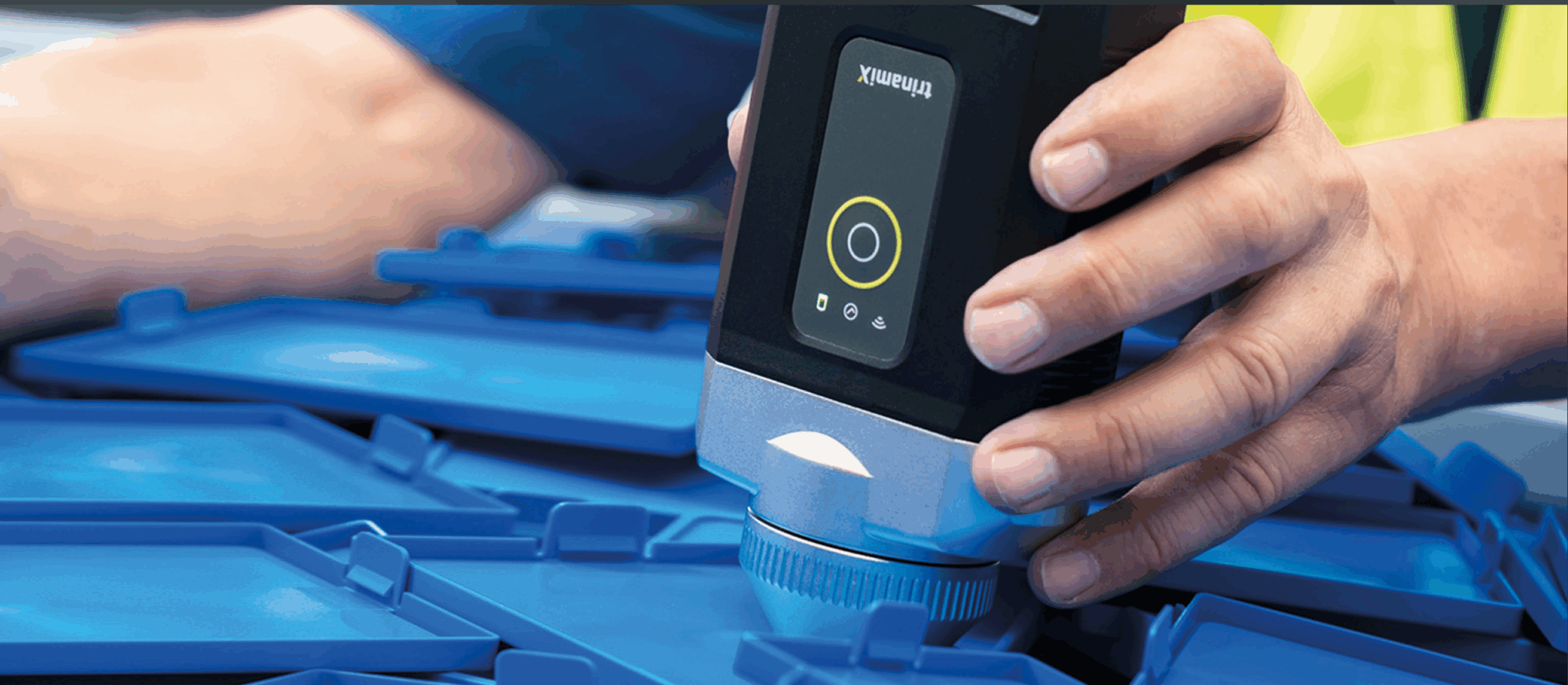
The workflow is performed with the trinamiX PAL One and the Multi-Material Film application. The device functions as a portable screening tool for flexible packaging structure analysis and recyclability assessment workflows, not as a replacement for laboratory analysis.
For the application itself, see the Multi-Material Film Check product page.
Test Your Packaging Material
If you are evaluating flexible packaging structures, a sample test can help determine whether portable NIR screening is suitable for your recyclability assessment workflow and material evaluation process.
This is particularly relevant for PE/PA films, multilayer laminate structures, unclear flexible packaging samples, or internal packaging development comparisons where an early screening result is useful before deeper analysis.
Request a packaging material test by filling the form at the right.
FAQ: Flexible Packaging Recyclability Screening
Can portable NIR determine whether packaging is fully recyclable?
No. Portable NIR supports early recyclability screening and flexible packaging structure analysis, but it does not replace formal recyclability testing, certification, or laboratory analysis.
What is multilayer packaging?
Multilayer packaging combines multiple material layers such as PE, PA, EVOH, or PET to achieve barrier performance, sealing behavior, or product protection. These multilayer laminate structures may affect recycling stream compatibility.
Can it identify every layer in a multilayer film?
No. The method cannot provide a complete layer stack or layer thickness analysis. It is intended for multilayer packaging screening and early recyclability assessment workflows.
Can it detect PA in flexible packaging?
For suitable PE/PA film structures, the application can provide an approximate PA content indication. This should be treated as a screening result rather than a full analytical measurement.
How is this different from reflectivity testing?
Reflectivity testing evaluates NIR detectability and sortability, while multi-material film screening evaluates whether a flexible film behaves like a mono-material or multilayer packaging structure.