
Textile Recycling Scanner
for PA6 / PA66 Identification and Fiber Sorting
Solid Scanner provides a portable trinamiX PAL One NIR textile sorting scanner for workflows where fast textile material identification is needed directly at the sorting station, during incoming goods inspection, or throughout textile recycling preparation.
The strongest use case is PA6 / PA66 identification. PAL One can support differentiation between Nylon 6 (PA6) and Nylon 66 (PA66), a critical distinction for textile recycling and polyamide recovery. The same handheld NIR textile scanner also supports textile material identification, blend checks, wool sorting, and selected special textile applications.
A textile sorting scanner uses near-infrared (NIR) spectroscopy to support rapid fiber identification and material sorting directly within textile recycling workflows.
Why Textile Sorting Needs More Than Visual Inspection
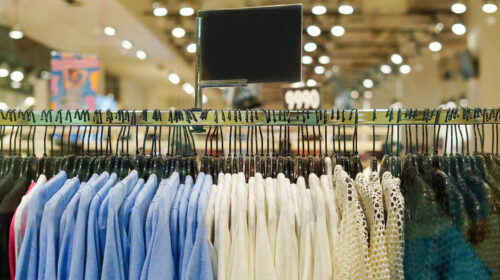
Mixed, wrong-labelled, damaged, or undocumented materials are very common, especially in Fast Fashion.
Textile recyclers often work with mixed, labelled, damaged, or undocumented materials. Visual inspection is fast, but it cannot reliably distinguish fiber chemistry, blend composition, or nylon variants.
This creates problems when materials are prepared for reuse, mechanical recycling, chemical recycling, or higher-value recovery routes.
- Mixed fibers reduce recycling quality.
- Incorrect sorting can contaminate material streams.
- Labels are often missing, wrong, or incomplete.
- PA6 and PA66 are difficult to distinguish manually.
PA6 vs PA66 Identification for Textile Recycling
PA6 and PA66 are both polyamides, but they are not interchangeable in recycling workflows. If they are mixed unintentionally, downstream processing, material quality, and recovery value can be affected.
Portable NIR screening can support fast differentiation between PA6 and PA66 directly in textile sorting and textile recycling workflows. This is one of the strongest PAL One-specific advantages for textile recycling applications.
How do you distinguish PA6 from PA66 in textile recycling?
Portable NIR measurement can support rapid identification of PA6 and PA66 textile materials directly at the sorting stage, helping operators separate nylon fractions before further processing.
- Supports nylon sorting before recycling or material recovery.
- Helps separate PA6 and PA66 textile fractions.
- Reduces dependence on slow laboratory checks for every sample.
- Supports more consistent textile pre-sorting decisions.
For deeper technical context, see the article PA6 vs PA66 textile recycling guide.
Where the Textile Sorting Scanner Fits
The system is designed for practical textile screening, not laboratory characterization. It is most useful when teams need fast sorting decisions at material intake, in pre-sorting, or during smaller textile recycling operations. Read here in detail, how smaller operators can modernize textile recycling with small investments.
What Can Be Identified with a NIR Textile Scanner?
The exact result depends on the licensed textile application and sample type. The system can support common textile material identification tasks and selected textile sorting workflows.
Can NIR identify textile fibers?
NIR spectroscopy can support identification of many common textile materials and fiber categories within the scope of the selected application.
| Application area | Typical use |
|---|---|
| Textile material identification | Identify common fibers and textile categories in sorting workflows. |
| Blend analysis | Support classification of relevant textile blends within the application scope. |
| PA6 / PA66 differentiation | Separate nylon variants where PA6 and PA66 must not be mixed. |
| Wool sorting | Support identification of wool-rich textile materials. |
| Carpet and PU mattress checks | Available as special textile-related applications, but not the primary workflow focus. |
How the Measurement Workflow Works
The textile scanner workflow is designed for fast use by operators. A sample is measured directly with the handheld NIR spectrometer, and the result appears in the trinamiX application environment.
- Place the spectrometer directly on the textile sample.
- Start the scan in the relevant textile application.
- Review the result on the mobile or desktop app.
- Use the result to support sorting, documentation, or further testing decisions.
For general device workflow information, see the trinamiX NIR spectrometer overview.
You are currently viewing a placeholder content from Vimeo. To access the actual content, click the button below. Please note that doing so will share data with third-party providers.
Video shows how to use trinamiX PAL One textile analyzer in combination with table integration (add-on) for faster sorting.
From Handheld Sorting to Larger Workflows
Modularity is useful, but it should be understood as an implementation advantage rather than the main reason to choose the system. The primary reason is fast textile material information. The modular setup helps adapt the system to different workflows once the use case is clear.
- Start with handheld textile identification.
- Add PA6 / PA66 or wool applications where relevant.
- Use the same platform across selected plastic and textile workflows.
- Discuss table integration or semi-automated setups if manual scanning becomes too slow.
The image on the right shows the trinamiX PAL One
textile scanner in operation, integrated with a table.

What This Method Can and Cannot Do
Portable NIR textile sorting is a screening method. It supports faster material decisions, but it does not replace all laboratory methods or solve every textile sorting problem.
| Question | Practical answer |
|---|---|
| Can it support PA6 / PA66 differentiation? | Yes, within the scope of the relevant textile application and suitable samples. |
| Can it replace all lab testing? | No. It supports fast screening and sorting decisions, but laboratory analysis may still be needed for critical cases. |
| Can it sort every textile automatically? | No. It supports manual or semi-manual workflows unless integrated into a larger setup. |
| Can it identify heavily contaminated or complex materials? | Results depend on sample condition, surface, composition, and application scope. |
Technical Resources
Related Technical Articles
The following articles provide additional context for textile recycling and PA6 / PA66 identification.
Commercial Setup
The system can be configured based on the textile workflow and required applications. Pricing is not shown on this page because the relevant configuration depends on the selected software modules, deployment model, and whether additional applications or table integration are needed.
For many users, the best next step is to discuss the textile samples, required result categories, and expected workflow before selecting the final configuration.

Discuss Your Textile Sorting Workflow
Use the form to describe your material stream and sorting goal. The most useful information is the fiber types you expect, whether PA6 / PA66 differentiation is relevant, the number of samples or batches, and whether the workflow is handheld or table-based.
FAQ: Textile Sorting with Portable NIR
Can PAL One distinguish PA6 from PA66?
Yes. PAL One can support PA6 / PA66 identification and differentiation within the scope of the relevant textile application and suitable samples.
Is this only for nylon sorting?
No. Nylon sorting is the strongest differentiator, but the system also supports broader textile material identification, fiber classification, and selected textile-related applications.
Can the system be used by small textile recyclers?
Yes. A handheld setup can be used as an entry workflow before larger or semi-automated sorting concepts are considered.
Does the system replace laboratory testing?
No. It supports fast material screening and sorting decisions. Laboratory testing may still be needed for critical or disputed cases.
Can the setup be expanded later?
Yes. The system is modular, but upgradeability should be seen as an implementation advantage rather than the main buying reason.