

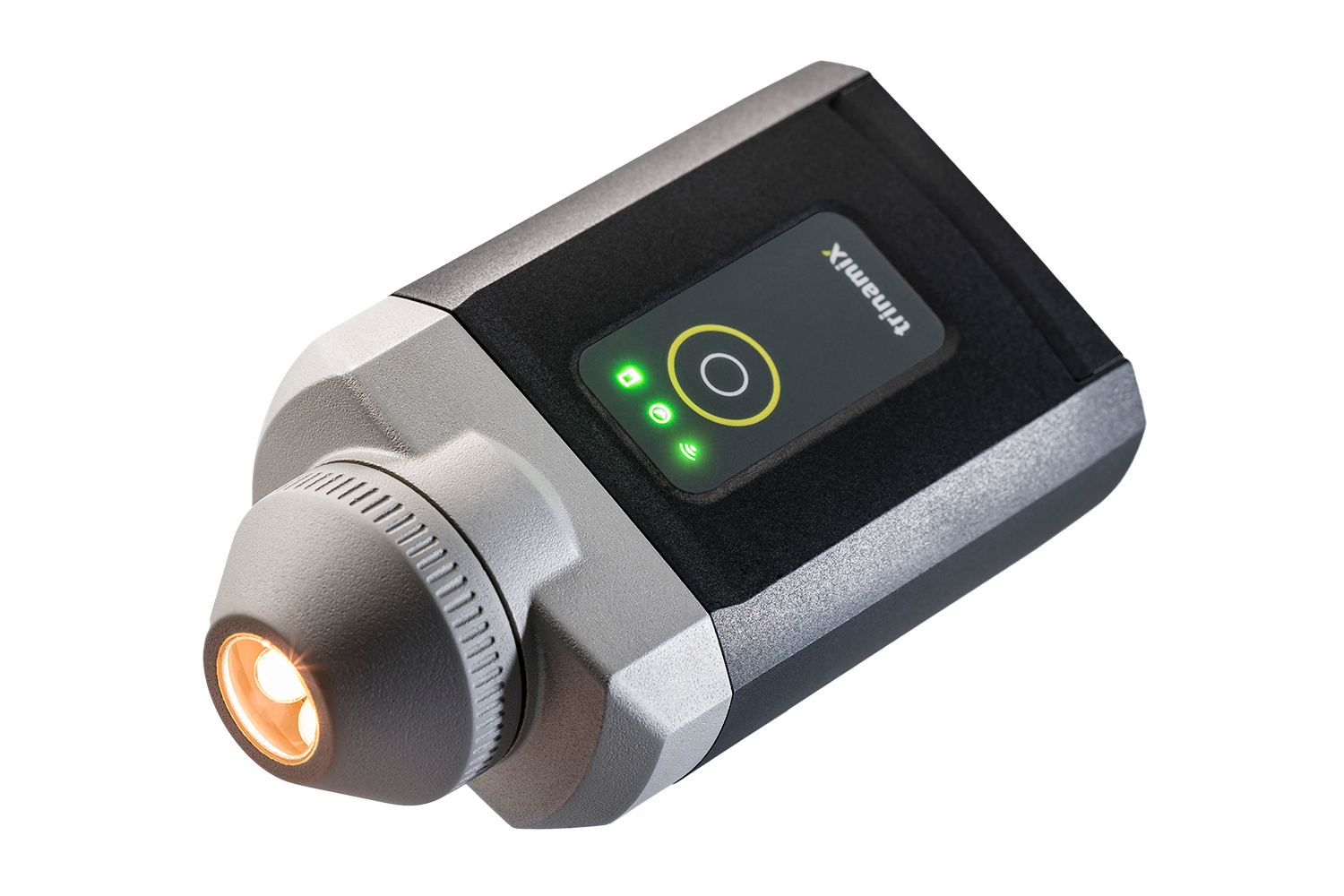
trinamiX Multi-Material Film Check
The trinamiX Multi-Material Film Check is a PAL One application for screening flexible packaging films using portable NIR analysis. It helps classify suitable film samples as mono-material, PE/PA with approximate PA content indication, or multi-material.
This page is focused on the application itself: what it detects, how the measurement works, what results to expect, and where the technical limits are. For the broader packaging workflow, see Flexible Packaging Recyclability Screening.
Table of Contents
What Is Multi-Material Film Detection?
Multi-material film detection is a screening process used to distinguish mono-material flexible packaging films from more complex multilayer structures. Using handheld NIR spectroscopy, the application evaluates whether a suitable film sample behaves like PE, PP, PET, PA, PE/PA, or a broader multi-material structure.
The application is designed for fast, practical screening of flexible packaging films. It is useful when you need an early indication of whether a film behaves like a mono-material structure or should be treated as a more complex multi-material structure.
It is not a laboratory replacement and does not provide a complete layer-by-layer analysis. Its value is in fast technical qualification before deeper testing or material decisions.
Supported Result Categories
The application classifies suitable flexible packaging film samples into practical result categories. These categories support packaging development, supplier comparison, and recycling-oriented screening workflows.
| Result category | What it means | Typical use |
|---|---|---|
| Mono-material film | Film is classified as PE, PP, PET, or PA within the scope of the model. | Initial mono-material screening and material comparison. |
| PE/PA film with PA indication | PE-based film with approximate PA content indication. | Screening PE/PA flexible packaging structures where PA content is relevant. |
| Multi-material film | Film does not fit the mono-material or PE/PA result categories. | Identification of multilayer or more complex film structures for further review. |
Typical Application Outputs
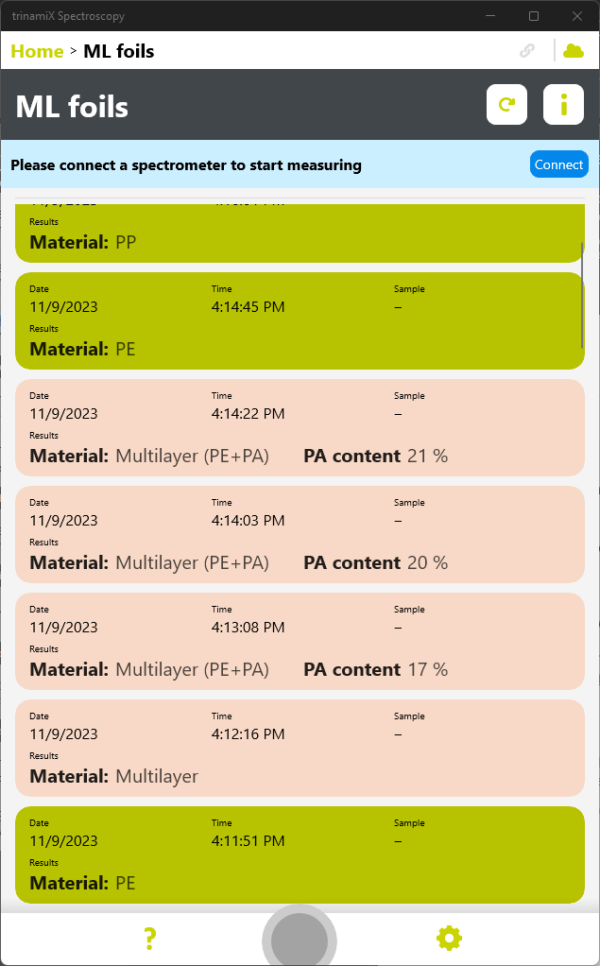
The result is shown directly in the trinamiX application interface. Typical outputs may include:
These outputs are intended for screening flexible packaging films and should not be interpreted as a complete multilayer film analysis.
Right side: Screenshot of the application interface and example result categories.
Can NIR Detect PA in Flexible Packaging?
For suitable PE/PA flexible packaging structures, the application can provide an approximate PA content indication using handheld NIR spectroscopy. The result supports fast screening and comparison workflows but is not laboratory-grade quantification.
The application does not identify the complete layer structure of multilayer films and does not measure individual layer thickness.
Measurement Workflow
The measurement is performed directly on the film sample using the PAL One handheld NIR spectrometer. Correct sample handling is important for reliable results.
1. Prepare the Film
Place the white reference target behind a single layer of the film sample where applicable. This improves measurement consistency, especially for thin or transparent flexible films.
2. Measure in Direct Contact
Place the device in direct contact with the front side of the film and start the scan in the application.
3. Review the Result
The application displays the result category. Mono-material and multi-material results are separated, and suitable PE/PA films may include an approximate PA content indication.
Technical Resources
The following technical resources support evaluation of the Multi-Material Film Check application and its suitability for flexible packaging film screening workflows.
You are currently viewing a placeholder content from Vimeo. To access the actual content, click the button below. Please note that doing so will share data with third-party providers.
More InformationWhere This Application Is Useful
The strongest use cases are screening tasks where a fast first indication is useful before deeper analysis. The application is most relevant when many flexible packaging samples need to be narrowed down or compared.
- Packaging development: compare film concepts during early material selection.
- Supplier comparison: check whether supplied films show similar structural behavior.
- Internal screening: identify samples that should be reviewed more closely.
- Recycling pre-check: separate likely mono-material candidates from more complex flexible packaging films.
Can NIR Identify All Layers in Multilayer Film?
No. The Multi-Material Film Check is a screening application and not a full multilayer film analysis method.
| Question | Answer |
|---|---|
| Full layer stack? | No. The application does not identify the complete layer structure. |
| Layer thickness? | No. It does not measure individual layer thickness. |
| Adhesives or tie layers? | No. These are not reliably identified. |
| Metallized films? | Limited. Metallized layers can block or distort the NIR signal. |
| Certification-grade recyclability result? | No. The application supports screening, not certification. |
Metallized Films and NIR Limitations
Metallized films require special caution. Metallized layers can block NIR light and reduce the reliability of the result. In some cases, measuring from both sides may provide additional information, but results should still be treated as screening information only.
Relationship to Reflectivity Testing
The Multi-Material Film Check is different from reflectivity testing. This application screens flexible film structure categories such as mono-material, PE/PA, and multi-material. Reflectivity testing evaluates whether a plastic sample is detectable by NIR sorting systems.
For NIR detectability and sortability workflows, see the trinamiX Reflectivity Check.
Delivery Scope and Commercial Setup
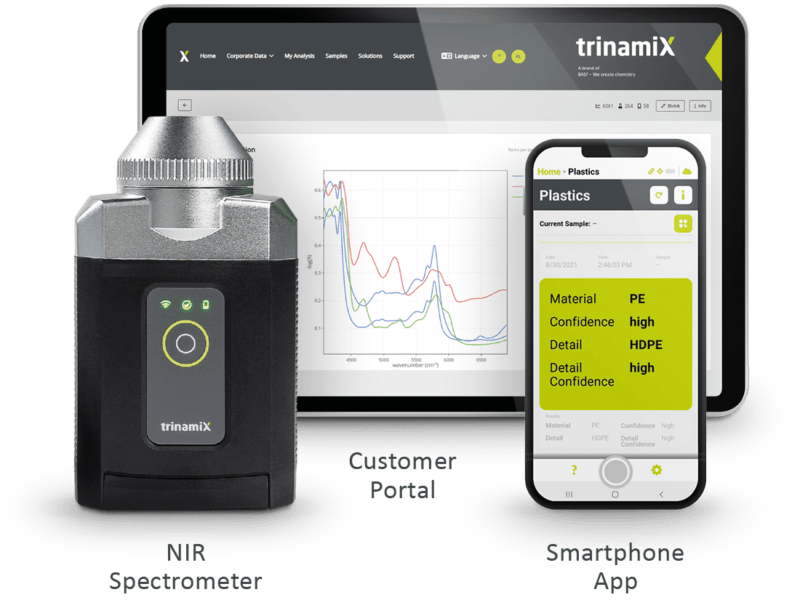
The application runs on the trinamiX PAL One handheld NIR spectrometer. It can be offered as part of a configured PAL One setup or as an additional software application for suitable existing PAL One users.
- PAL One handheld NIR spectrometer
- Multi-Material Film Check software application
- Access to trinamiX app environment
- Cloud-based result storage and reporting options
- Basic onboarding for measurement workflow and result interpretation
Availability, license duration, and pricing depend on the configured setup. For broader device details, see the trinamiX NIR Solutions overview.
Download Technical Resources
Request a Film Sample Test
FAQ: trinamiX Multi-Material Film Check
What is multilayer film detection?
Multilayer film detection is a screening process used to distinguish mono-material films from more complex flexible packaging structures using methods such as NIR spectroscopy.
Can the application identify all layers in a flexible film?
No. It does not provide a full layer-by-layer structure. It classifies suitable samples into practical screening categories.
Can NIR detect PA in flexible packaging?
For suitable PE/PA structures, the application can provide an approximate PA content indication. This should be understood as a screening result, not laboratory-grade quantification.
Can metallized films be analyzed with handheld NIR?
Metallized layers can block NIR light and may make results unreliable. Such samples should be evaluated carefully and confirmed with additional methods if necessary.
Is this the same as reflectivity testing?
No. Reflectivity testing checks NIR detectability and sortability. The Multi-Material Film Check screens flexible film structure categories.
Does the Multi-Material Film Check replace recyclability certification?
No. The application supports internal screening and technical evaluation workflows but does not replace formal recyclability testing or certification.