


NIR Moisture Measurement: Capabilities, Limitations and Industrial Applications
Near-infrared spectroscopy (NIR) is widely used to detect and monitor moisture because water has strong absorption features in the NIR region. For industrial quality control, this makes NIR useful for fast, non-destructive checks of materials such as polymers, powders, granulates, agricultural products, biomass, paper, textiles and process intermediates.
NIR moisture measurement is not a universal replacement for reference laboratory methods. It works best when the material, sample presentation and calibration model are well controlled. For quality managers, the key question is therefore not whether NIR can “see” water, but whether it can measure the relevant moisture variation reliably enough for the specific process decision.
Why NIR Can Detect Moisture
Water absorbs near-infrared radiation because of overtone and combination vibrations of the O-H bond. These absorption features influence the reflected or transmitted spectrum of a material. When moisture content changes, the NIR spectrum changes as well.
Common industrial NIR spectrometers often operate in ranges such as 900-1700 nm, 1350-2150 nm or 900-2400 nm. Water-related information can appear in several parts of these ranges, depending on the material, optical setup and measurement mode. In compact 900-1700 nm systems, moisture-related changes are often visible around the 1400 nm region.
For a broader explanation of wavelength ranges, see our guide to spectroscopy wavelength ranges.
What NIR Moisture Measurement Can Do Well
NIR is especially useful when moisture variation creates a measurable spectral change and when many samples must be checked quickly. Typical advantages include:
- non-destructive measurement
- measurement in seconds
- no reagents or sample preparation in many cases
- potential for at-line, handheld or inline use
- compatibility with chemometric models for quantitative estimation
This makes NIR attractive for incoming goods inspection, production quality control, drying-process monitoring and material comparison tasks.
Industrial Application Areas
NIR moisture analysis is used across many industries. In food, feed and agriculture, moisture affects shelf life, flowability and commercial value. In biomass and paper, it influences combustion behavior, storage stability and process efficiency. In chemicals, powders and granulates, moisture can affect handling, reaction behavior and product quality.
In plastics, moisture is important for processing and material performance, but it is also one of the more difficult NIR moisture applications. This distinction is important: NIR can often detect water-related spectral differences in polymers, but precise moisture quantification in plastics usually requires controlled calibration and validation.
Example: Detecting Water Absorption in Polyamide
Polyamides such as PA6 and PA66 can absorb water from the environment. This changes material properties such as stiffness, elongation, impact behavior and dimensional stability. For quality control, unknown water absorption can therefore become relevant before processing, testing or final use.
NIR can distinguish polyamide samples with different moisture states when the water absorption creates a clear enough spectral difference. In the original application example, PA samples with different water contents showed visible spectral differences in the NIR range. This makes NIR useful as a fast comparative method for checking whether samples are dry, conditioned or moisture-affected.
Limitations in Plastics Moisture Measurement
Moisture measurement in plastics is more demanding than moisture measurement in many bulk materials. Water concentrations are often low, while the polymer matrix itself produces strong NIR absorption bands. Additives, fillers, pigments, crystallinity, surface roughness and sample geometry can further influence the spectrum.
For this reason, handheld NIR systems used for polymer identification should not automatically be treated as precise moisture analyzers. They are very useful for material identification and spectral comparison, but quantitative polymer moisture measurement normally requires a dedicated calibration model for the specific polymer, grade, moisture range and measurement setup.
For plastics identification and polymer-specific limitations, see our page on portable plastic identification with NIR.
How Chemometric Modelling Supports Moisture Measurement
NIR spectra are rarely interpreted from a single wavelength alone. In industrial use, moisture measurement is usually based on a chemometric model. This model connects measured spectra with reference moisture values from a trusted laboratory method.
A simple workflow for quality management is:
- Collect representative samples across the expected moisture range.
- Measure each sample with the NIR spectrometer under stable conditions.
- Determine reference moisture values using the agreed laboratory method.
- Build a calibration model that links spectral changes to moisture values.
- Validate the model with independent samples before using it for routine decisions.
The result is not just a sensor reading, but a calibrated decision tool. The quality of the result depends on the quality of the reference data, sample coverage, measurement repeatability and validation strategy.
For application-specific model development, see Solid Scanner’s spectral sensing and chemometric modelling expertise.
Selecting a Suitable NIR Setup
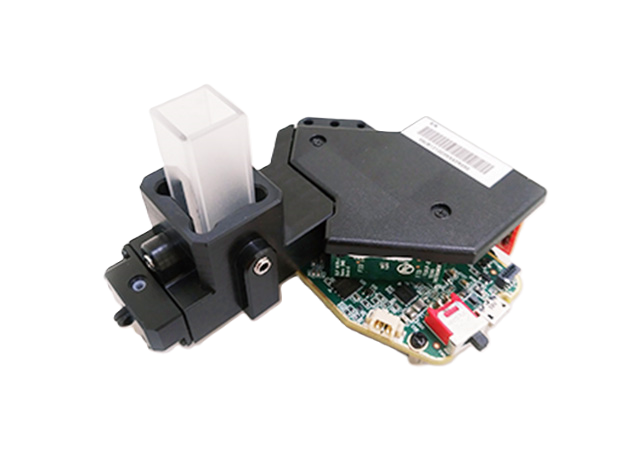
The right NIR setup depends on the material and measurement task. Reflective systems are often used for solids, granulates, powders and surfaces. Transmissive systems can be useful for liquids, films or defined sample cells. Wider wavelength ranges can provide additional spectral information, but they do not remove the need for calibration.
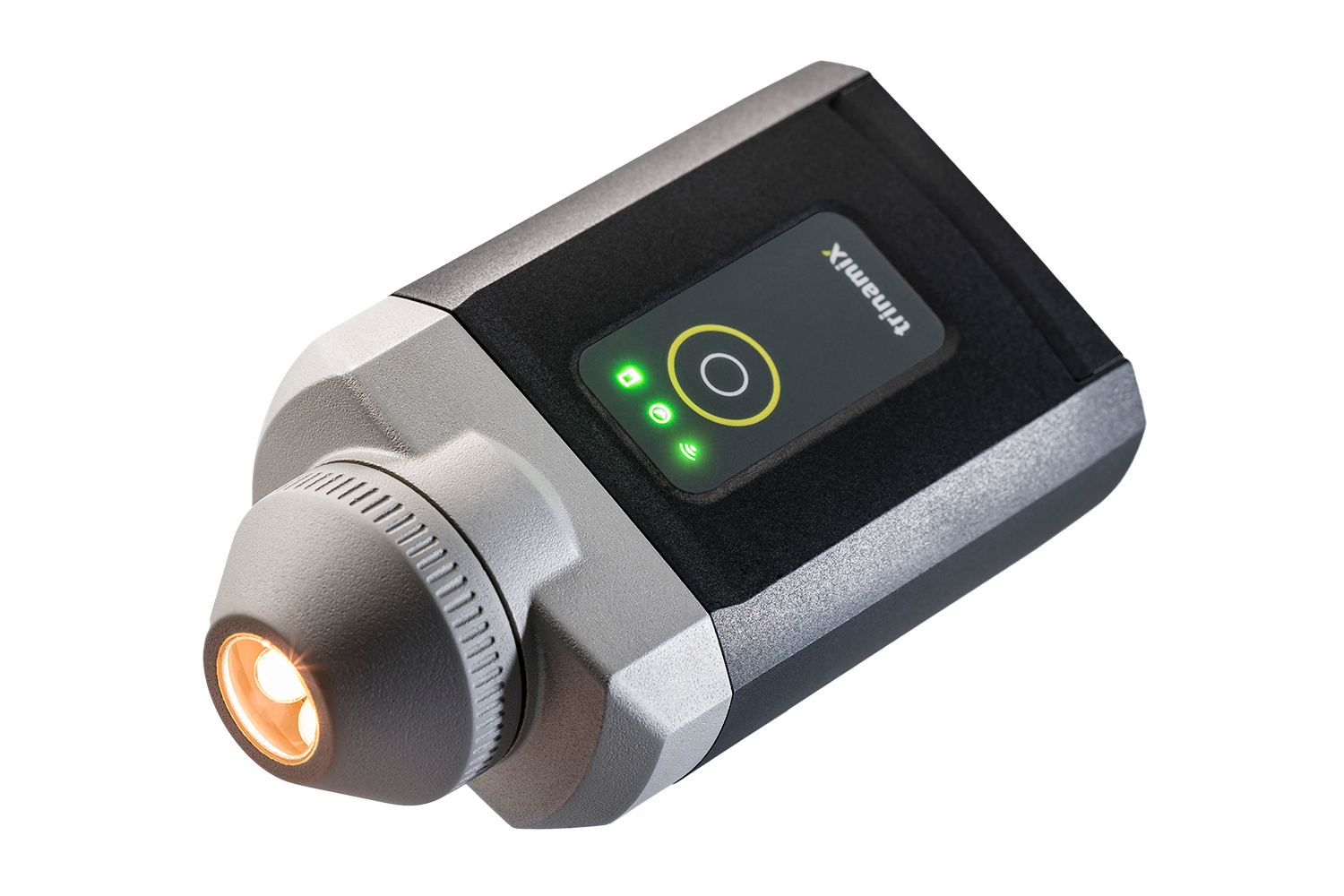
Compact Inno Spectra NIR spectrometers are available in several wavelength ranges, including 900-1700 nm, 1350-2150 nm and 900-2400 nm. These systems can be used for laboratory evaluation, feasibility studies and application-specific NIR method development.
Browse Inno Spectra NIR spectrometers or compare models such as the Inno Spectra NIR-S-G1 900-1700 nm reflective spectrometer and the Inno Spectra NIR-M-R15 900-2400 nm reflective spectrometer.
When NIR Moisture Measurement Is a Good Fit
NIR is a good candidate when moisture variation is expected to influence the spectrum, the sample type is reasonably consistent, and a reliable reference method is available for calibration. It is especially attractive when conventional moisture testing is too slow for routine process decisions.
NIR is less suitable as a direct plug-and-play moisture method when the moisture level is very low, the material formulation varies strongly, or the optical measurement conditions cannot be controlled.
Practical Summary for Quality Managers
NIR moisture measurement is powerful when it is treated as a calibrated spectral method. It can deliver fast, non-destructive moisture information across many industrial materials. However, its reliability depends on the material, the instrument, the measurement setup and the calibration model.
For plastics, NIR can detect moisture-related spectral differences in suitable cases, but precise quantification is application-specific. For cross-industry quality control, the best approach is to evaluate real samples, build a representative calibration and validate the result against a trusted reference method.
Need to evaluate whether NIR can measure moisture in your material? Send sample information or contact Solid Scanner for an application assessment.