

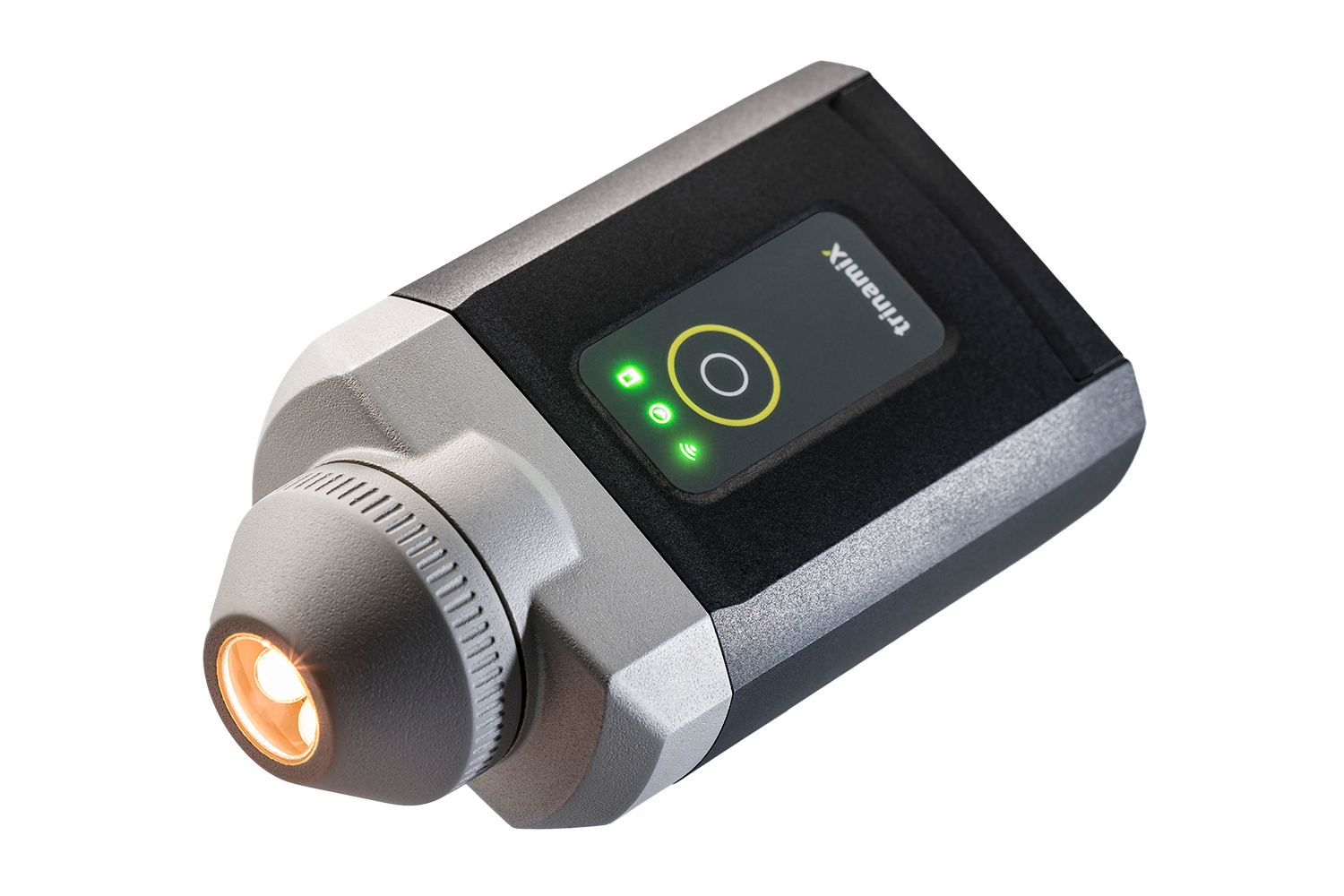
trinamiX Reflectivity Check
The trinamiX Reflectivity Check is a PAL One application for measuring NIR reflectivity of plastic packaging samples. It helps packaging teams evaluate whether a plastic sample is likely detectable by NIR optical sorting systems used in recycling facilities.
What is the trinamiX Reflectivity Check?
The trinamiX Reflectivity Check is a PAL One application that performs a plastic reflectivity test by measuring NIR reflectivity. It supports early packaging sortability screening by identifying materials that may be difficult for optical sorting systems to detect.
This is a product and application page. For the broader workflow, methodology, and sortability context, see plastic NIR sortability testing workflow.
Request sample test | Request rental availability | Download trinamiX Reflectivity Check flyer
NIR Reflectivity Testing for Plastic Packaging
The application measures how strongly a plastic sample reflects near-infrared light. Low NIR reflectivity can indicate that the material may be difficult for optical sorting systems to detect reliably.
- Measures NIR reflectivity of plastic packaging and components
- Supports plastic sortability testing and early screening
- Helps compare pigments, additives, coatings, labels, and material variants
- Supports packaging R&D and supplier comparison
- Stores results in the trinamiX application and customer portal environment
Typical Outputs
The result helps users interpret whether a sample may present a detectability risk in NIR-based optical sorting.
| Output | Practical meaning |
|---|---|
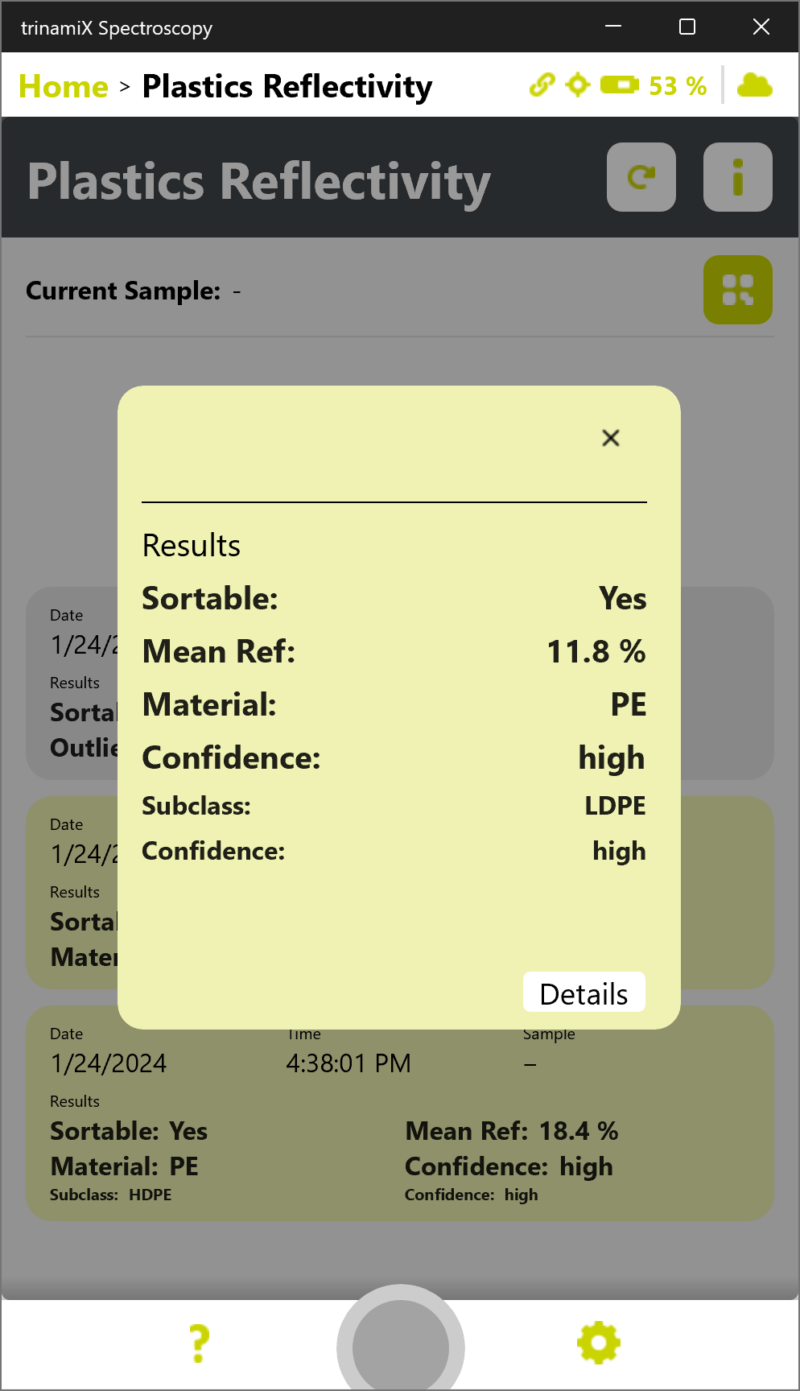
| NIR reflectivity value | Indicates how strongly the sample reflects near-infrared light. |
| Plastic identification result | Shows polymer identification where supported by the application. |
| Sortability indication | Supports early assessment of detectability risk. |
| Stored measurement record | Supports documentation, comparison, and internal reporting. |
Engineering Reference: 10% NIR Reflectivity Threshold
As a practical screening guideline, plastic samples with NIR reflectivity below approximately 10% may be difficult for optical sorting systems to detect reliably.
This threshold is useful for early development decisions, but it should not be treated as standalone proof of recyclability, compliance, certification, or successful sorting in every recycling facility.
Measurement Workflow
The measurement workflow is designed for fast NIR reflectivity testing on physical plastic samples. The PAL One device is placed directly on the sample, and the result is displayed through the trinamiX application environment.
- Place the PAL One spectrometer directly on the plastic sample.
- Start the Reflectivity Check application.
- Measure NIR reflectivity and polymer identification where supported.
- Review the result in the application.
- Use the result for design comparison, supplier review, or sample selection for external testing.
Plastic Samples Suitable for Reflectivity Testing
The Reflectivity Check is most useful for packaging samples and plastic components where NIR detectability is uncertain or design decisions may affect sortability.
- Rigid plastic packaging
- Black or dark-colored plastic samples
- Packaging with pigments, additives, or coatings
- Labels, sleeves, or surface treatments where detectability is relevant
- Supplier samples and design alternatives
Compatible Plastic Classes
The application is based on the 10 Plastics Reflectivity reference environment and is relevant for common plastic materials used in packaging and recycling workflows.
- PET
- HDPE and LDPE
- PP
- PS
- ABS
- PC
- PA
- PVC
- PLA
Where This Application Is Useful
The strongest use case is early-stage screening before external validation. The application helps packaging teams identify NIR detectability risks before investing in certification, pilot-scale sorting, or larger production decisions.
Packaging R&D
Compare material alternatives, pigments, additives, labels, and coatings during packaging development.
Supplier and Batch Comparison
Check whether supplied samples behave similarly in NIR reflectivity measurements.
Pre-Validation Screening
Identify low-reflectivity samples before external recyclability testing or pilot sorting trials.
Documentation and Internal QA
Store measurement records for internal comparison, project documentation, and supplier communication.
Relationship to PPWR, SB343 and Recyclability Claims
The Reflectivity Check can support packaging development work related to sortability and recyclability claims, but it does not replace regulatory assessment, external certification, or recyclability validation.
For the broader regulatory context, see PPWR packaging compliance and packaging sortability requirements. For the complete methodology, see plastic reflectivity and sortability testing workflow.
Data Access and Documentation
Measurement results can be stored in the trinamiX customer portal environment. This supports comparison of historical measurements, internal documentation, and export of relevant results.
Data handling and cloud access depend on the configured trinamiX setup and license environment.
Bundle and Access Options
The Reflectivity Check can be configured depending on whether you already use a PAL One device or need a complete setup.
- Complete setup: PAL One device with Reflectivity Check application
- Software add-on: Reflectivity Check for suitable existing PAL One users
- Evaluation package: project-based access for pilot testing or packaging development projects
- Sample test: practical first step if you are unsure whether your packaging requires NIR reflectivity testing

What This Application Cannot Replace
The Reflectivity Check is a practical screening method and should be used with clear expectations.
| Question | Practical answer |
|---|---|
| Does it prove packaging is recyclable? | No. It supports early NIR detectability screening. |
| Does it replace external recyclability testing or certification? | No. External testing and certification may still be required. |
| Does it simulate every sorting facility? | No. It provides NIR reflectivity screening, not facility-specific sorting simulation. |
| Can it support design decisions? | Yes. This is its strongest role. |
Request a Packaging Sample Test
If you are unsure whether your packaging material is detectable by NIR sorting systems, a packaging reflectivity test is the most practical first step. This can help determine whether the Reflectivity Check is relevant for your development or validation workflow.
Request Rental Availability
For temporary packaging development projects, supplier comparisons, or pre-validation screening, rental or evaluation access can be discussed based on project duration, location, and expected sample volume.
Downloads
FAQ: trinamiX Reflectivity Check
What is the trinamiX Reflectivity Check?
It is a PAL One application for measuring NIR reflectivity of plastic samples and supporting early packaging sortability screening.
What is the 10 Plastics Reflectivity application?
It is the trinamiX application environment used to compare measured plastic samples with reflectivity reference data for common plastic materials.
Can it test black plastic packaging?
Yes. Black and dark-colored plastics are common use cases because some pigments strongly reduce NIR reflectivity and optical detectability.
Does it replace APR, RecyClass, or pilot sorting tests?
No. It is a screening method that supports early design decisions before external testing or certification workflows.
Can existing PAL One users add the application?
Yes, where the device and license setup are suitable. The application can be discussed as a software add-on for existing PAL One users.